.png)

After two decades of working with leaders and teams, I’ve learned this truth the hard way: quiet teams are rarely healthy teams.
On the surface, they look great. Meetings end on time. No one argues. Decisions seem to land effortlessly. Leaders often tell me, “We’re lucky—there’s just no drama here.”
But beneath that calm exterior is one of the most common—and costly—mistakes teams make: confusing silence with harmony.
I call it the Harmony Trap.
And through the lens of The Five Behaviors®, this trap shows up most clearly as a lack of healthy conflict.
Silence Is Not the Absence of Conflict—It’s the Presence of Fear
In truly cohesive teams, conflict doesn’t disappear. It changes form.
According to The Five Behaviors®, productive teams engage in conflict around ideas. They debate. They challenge assumptions. They push back—not to win, but to arrive at the best answer.
When teams fall into the Harmony Trap, conflict doesn’t vanish. It goes underground.
What replaces it looks like this:
- Polite nodding instead of honest disagreement
- “I’m fine with whatever” instead of real buy-in
- Side conversations after meetings instead of debate during them
This isn’t harmony. It’s self-protection.
People stay quiet not because they agree—but because speaking up feels risky.
The Real Root Cause: A Trust Gap
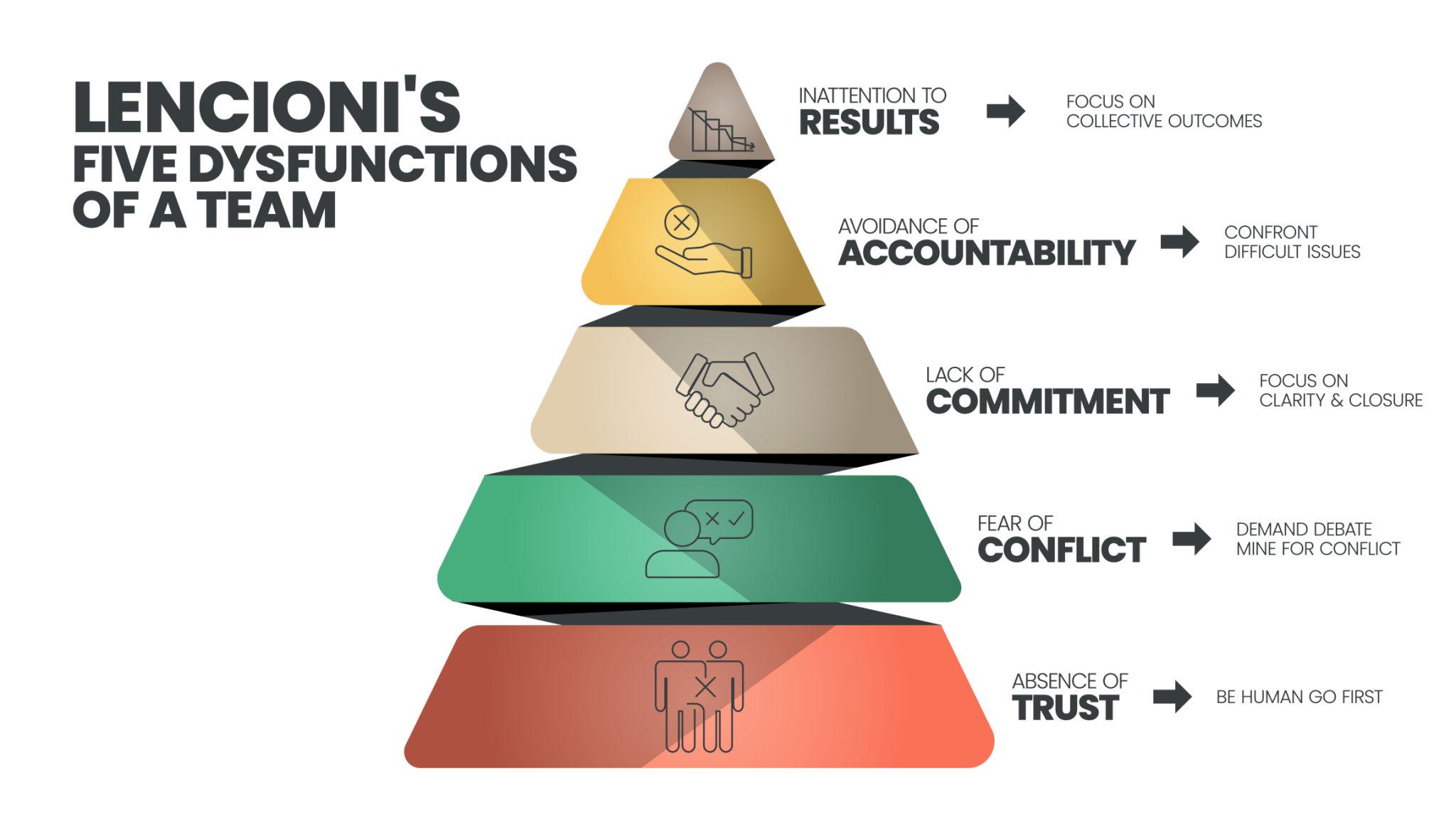
In the Five Behaviors model, conflict sits directly on top of trust—specifically, vulnerability-based trust.
When trust is low, teams don’t argue productively. They avoid conflict altogether.
Why?
- They don’t want to look incompetent
- They don’t want to damage relationships
- They don’t believe it’s safe to be candid
So silence becomes a coping mechanism.
Ironically, teams often justify this avoidance by saying, “We respect each other too much to argue.” In reality, they don’t trust each other enough to tell the truth.
How the Harmony Trap Undermines the Entire Team
This is where the damage compounds.
In The Five Behaviors®, each behavior builds on the one below it. When teams skip healthy conflict, the cracks spread upward:
1. Weak Commitment
Without open debate, decisions lack true buy-in. People nod in meetings but leave unconvinced.
2. Artificial Accountability
When no one challenged the decision, no one feels ownership. Holding peers accountable feels unfair—or pointless.
3. Compromised Results
Teams prioritize personal comfort over collective outcomes. The goal shifts from winning together to getting along.
In other words:
Silence today becomes underperformance tomorrow.
What Healthy Conflict Actually Looks Like (Hint: It’s Not Combat)
One reason teams avoid conflict is because they imagine worst-case scenarios—raised voices, bruised egos, damaged trust.
But healthy conflict looks very different.
On strong teams, conflict is:
- Focused on ideas, not people
- Energetic, not mean-spirited
- Temporary, not personal
You’ll hear phrases like:
- “Help me understand your thinking.”
- “I see it differently—can I explain why?”
- “I disagree, and I think this matters.”
There’s tension—but it’s productive tension.
And paradoxically, teams that argue well often trust each other more, not less.
Escaping the Harmony Trap: A Better Question for Leaders
If you’re leading a team that feels “too calm,” don’t ask:
“Why aren’t people speaking up?”
Ask instead:
“What have we taught people (explicitly or implicitly) about the cost of disagreeing here?”
Because teams don’t avoid conflict accidentally. They learn to.
Breaking the Harmony Trap requires leaders to:
- Model vulnerability before expecting candor
- Invite dissent—and reward it
- Normalize debate as a sign of respect, not dysfunction
When leaders go first, teams follow.
Final Thought: Choose Health Over Comfort
High-performing teams don’t choose harmony.
They choose health.
Health means trust strong enough to support conflict.
Conflict rich enough to drive commitment.
Commitment clear enough to fuel accountability.
And accountability relentless enough to deliver results.
So if your team feels quiet, polite, and conflict-free, don’t congratulate yourself too quickly.
You might not have harmony.
You might be stuck in the Harmony Trap.
Ready to move beyond artificial harmony?
Teams don’t need to argue more—they need to argue better. Our Five Behaviors® Team Development program helps teams build the trust and skills required to engage in healthy conflict, commit with clarity, and deliver real results.