The Five Behaviors®

Strengthen how people work together.

Build the trust, candor, commitment, and accountability that shared results depend on.

The Five Behaviors gives people a practical framework for examining how they contribute to teamwork. Russo Leadership offers two distinct facilitated programs: one for an intact team, and one for individuals who work across teams.

Watch: An introduction to The Five Behaviors. Open video in a new tab.

Choose by the work you want to strengthen

Develop this team. Or develop better teammates.

Are you working on how a specific team functions together, or how individuals contribute to every team they join?

An intact team

Team Development

Help a team examine its shared patterns, discuss its own assessment results, and agree how it will work together more effectively.

Who it serves
One established team of 5–12, with shared responsibilities and results.
What the assessment provides
Aggregate team survey results and individual DiSC insight.
What the team creates
Shared priorities, conflict norms, accountability commitments, and an action plan.

Individuals across teams

Personal Development

Help people understand their teamwork tendencies and practice behaviors they can bring to any team they work with.

Who it serves
A cohort of 8–24. Participants do not need to be on the same team.
What the assessment provides
An individual profile. No aggregate team data or team report.
What each person creates
Individual commitments to strengthen their contribution to teamwork.
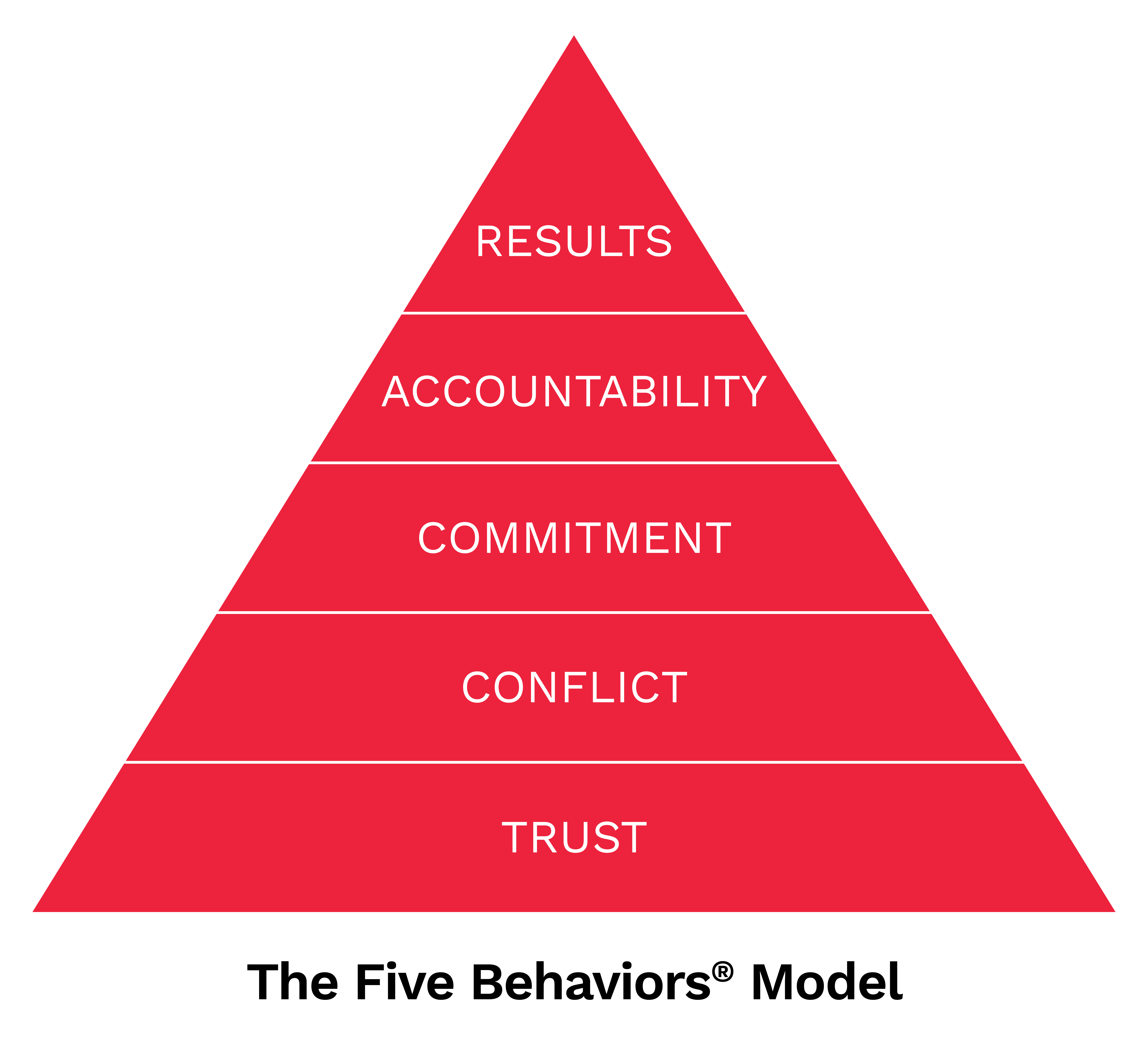
The Five Behaviors pyramid, from its foundation upward: Trust, Conflict, Commitment, Accountability, and Results.
The Five Behaviors® model, based on Patrick Lencioni’s work. View the model with full descriptions.

One shared model

Five behaviors that support shared results.

The model connects the quality of people’s working relationships with the way they debate, decide, follow through, and focus on collective outcomes.

  1. Trust

    Be willing to ask for help, acknowledge mistakes, and be open about limitations.

  2. Conflict

    Debate ideas openly and constructively so important concerns can be heard.

  3. Commitment

    Reach clarity about decisions and what people are agreeing to do.

  4. Accountability

    Address commitments and behaviors with one another, including when the conversation is uncomfortable.

  5. Results

    Keep collective outcomes in view when individual priorities compete for attention.

Team Development · 5–12 participants

Work on the patterns your team shares.

People may leave the same meeting with different understandings of what was decided, avoid the discussion that matters, or wait for the leader to address a missed commitment.

Team Development brings the whole team together to examine its own experience of the five behaviors and agree specific changes to how it works.

The experience

  1. Prepare the team and its leader

    We confirm the team’s readiness and shared responsibilities, meet separately with the leader, and arrange the assessments. The whole team participates.

  2. Discuss your team’s results

    Use aggregate survey results, individual profiles, and team maps to explore trust, conflict, commitment, accountability, and results. Differences in how members experience the team become part of the discussion.

  3. Agree what changes in practice

    Identify a top priority, establish conflict norms and accountability commitments, and define actions for individuals and the team together.

Format: An afternoon session, team dinner, and the following morning. A single full-day format is also available.

The team dinner creates time to connect after the trust-building work. Dinner and lodging are covered by the client; arrangements are agreed in advance.

Readiness matters. This program is for an established, interdependent team with a leader willing to participate openly. If the team is new or its membership is changing, we can discuss a model introduction and the right timing for the assessment.

Personal Development · 8–24 participants

Build practices people can bring to every team.

A person may work across several teams, projects, or departments. Their ability to ask for help, raise a concern, honor a decision, and give useful feedback travels with them.

Personal Development uses individual insight and facilitated practice to help participants understand their own contribution to teamwork. It fits leadership cohorts, new-manager groups, and people working across functions.

The experience

  1. Understand your tendencies

    Use your individual Five Behaviors profile to reflect on how you approach teamwork, including what feels comfortable and where you may need to stretch.

  2. Explore each behavior in practice

    Work through trust, conflict, commitment, accountability, and results using discussion, video, and activities. Connect each behavior to situations you encounter at work.

  3. Choose your contribution

    Identify specific actions you can take as a teammate and make individual commitments to carry into your working relationships.

Format: One in-person half-day session. Participants can come from different teams and do not need to know one another.

Planning the work

A few practical questions.

How do we choose between the two programs?

Choose Team Development when an intact team needs to examine how it works together toward shared results. Choose Personal Development when individuals across teams or a cohort need to strengthen their teamwork practices. The products use different assessments and produce different outputs; Personal Development is not a shorter Team Development program.

What counts as an intact team?

A group of 5–12 people who meet regularly, depend on one another, and share responsibility for results. Reporting to the same manager is not enough on its own. We discuss the team’s work and readiness before recommending Team Development.

What if our team is new or its membership is changing?

The assessed Team Development program works best when membership and working relationships are established. If the team is less than six to eight weeks old, is about to change membership, or is going through a merger or reorganization, we discuss timing. A model introduction without the team assessment may be a better starting point.

Does the whole team need to attend Team Development?

Yes, including the leader. The leader participates rather than facilitates and meets with us separately before the program. We agree dates that allow the whole team to attend.

Are Team Development assessment responses anonymous?

Team survey results are anonymous; individual DiSC styles are shared. The program examines the team’s shared work and uses aggregate survey results to support discussion. It is not an evaluation of individual performance.

Does Personal Development include a team report?

No. Personal Development provides individual profiles and individual development commitments. It does not produce aggregate team scores, a team map, or a team readout.

Can we use existing DiSC assessment results?

Existing Everything DiSC assessment data cannot be carried into the Personal Development assessment. Participants take the Five Behaviors assessment. If someone has already completed Five Behaviors Team Development, we check whether their existing data can be used when arranging access.

What are the delivery formats and timings?

Team Development is designed around an afternoon session, team dinner, and the following morning. A single full-day format is also available. Personal Development is an in-person half-day program with approximately 4¼ hours of learning and breaks; allow additional time for the close. We confirm the full schedule in the proposal.

What follow-up is available?

Team Development includes a written summary of the team’s agreed outcomes and a 30-day leader check-in. Where useful, a separately scoped Progress Report session can revisit the team’s experience three to six months later. Personal Development includes a sponsor check-in. Further facilitation or coaching requires its own scope.

Want to learn independently?

The Five Behaviors Personal Development is also available as a self-paced Academy course, with an individual assessment and 12 months of course access.

Explore self-paced learning

Start with your shared work

What would better teamwork make possible?

Tell us who you want to bring together, what their work requires, and what you want to be different. We’ll help you choose the program that fits.